Paper summary
Learn the path ratio that produces the desired split
Hash-based path selection can skew the switch’s throughput split away from the requested ratio.
CLEO investigates skew in hash-based ECMP path selection. It predicts the path ratio needed for a given traffic set and desired output throughput.
Learn a switch setting from measured traffic
The proof of concept collects 10,000 examples from Open vSwitch, recording the traffic set, path ratio and measured output. A multiclass neural network learns from 7,000 examples to predict a path ratio from the traffic set and desired output. The model learns the behavior of the measured switch.
| Role | Quantity |
|---|---|
| Input | Traffic set and desired output split |
| Prediction | Path-ratio setting |
| Validation | Traffic split measured after applying the setting |
Check the traffic split produced by the switch
For the remaining 3,000 examples, CLEO applies its predicted ratios to Open vSwitch and measures the resulting throughput. It reduces root mean square error between desired and actual path output by 75% relative to static path ratios. The evaluation uses two paths.
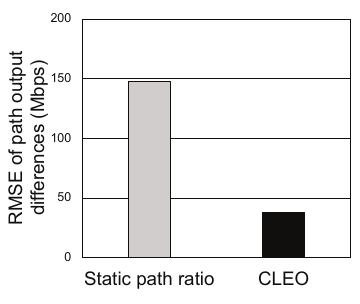 View full-size figure
Key takeaways
- The switch setting and the resulting traffic split are different quantities. CLEO learns the setting needed to realize a requested allocation.
- The result is judged in the data plane. Applying the predicted settings to the switch tests whether the learned correction actually reduces split error.