Paper summary
Share forwarding rules without dividing the address space
Address virtualization can preserve tenant separation while reducing repeated switch rules.
AggFlow addresses address-space limits and forwarding-rule overhead in SDN virtualization. It combines mapping-less address virtualization with hop-by-hop forwarding.
Separate tenant addresses from shared forwarding
An address supervisor manages tenant address information without assigning every virtual host a separate physical address mapping. The hop-by-hop forwarder translates virtual rules into physical rules and checks for duplicates. Compatible flows can therefore share forwarding entries along their route. Edge switches still perform address translation, so sharing is concentrated in the core.
| Component | Role |
|---|---|
| Address supervisor | Manage tenant address information |
| Hop-by-hop forwarder | Translate rules and reuse compatible entries |
| Edge switches | Translate packet addresses |
Save core rules without removing edge translation
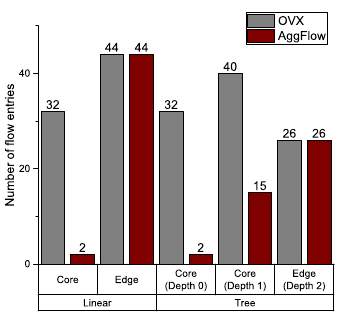
The OpenVirteX-based prototype is evaluated in Mininet linear and tree topologies. Core-switch entries fall by up to sixteenfold in the tested cases, while edge-entry counts do not decrease. Control-message traffic also falls, but translation incurs a small added processing delay. Steady UDP throughput is the same as OpenVirteX in the reported comparison. When a path already has compatible rules, a new ping flow starts with a lower round-trip time; that advantage does not apply in the same way when no rules exist yet.
 View full-size figure
Key takeaways
- Address-space scalability and rule scalability are related but distinct. Mapping-less addressing avoids per-host physical address assignment, while compatible flows share core forwarding entries.
- Savings concentrate where forwarding can be shared. Core entries fall in the evaluated topologies while edge translation remains per-flow work.