Paper summary
Divide tensors to match unequal CPUs
Small devices can fine-tune a model together more efficiently when faster workers receive a larger share of the computation.
On CPU-based edge devices, model computation and communication compete for the same processor. The paper finds that GPU-oriented pipeline parallelism suffers from this contention. Tensor parallelism separates these phases, but equal tensor partitions still leave faster devices waiting for slower ones.
Profile representative layers, then assign tensor shares
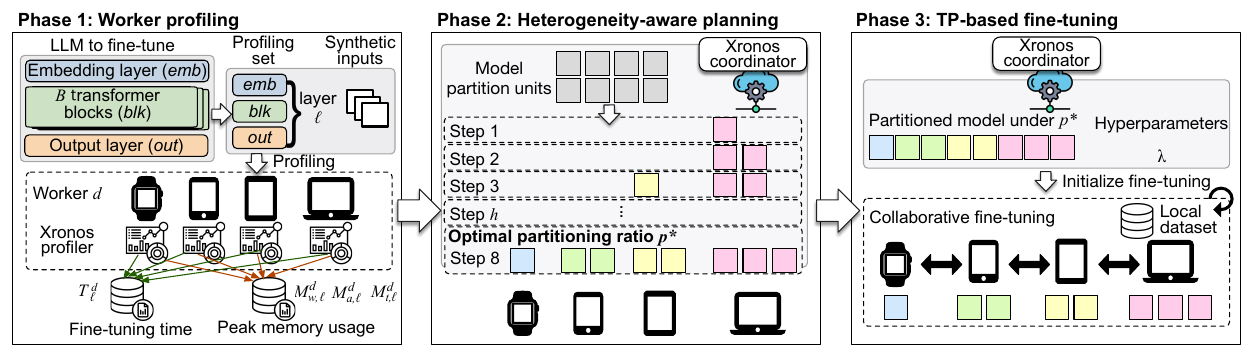
XRONOS profiles an embedding layer, one representative transformer block and the output layer on each worker. These measurements estimate layer computation time and memory use without profiling the full model.
Partition sizes must account for differences in device speed and memory.
A greedy planner assigns indivisible tensor units to workers, selecting placements that reduce estimated iteration time while respecting each device’s memory limit. The coordinator then launches synchronized tensor-parallel fine-tuning with the resulting unequal shares.
 View full-size figure
Check both iteration time and model accuracy
Tests use three-, four- and five-device sets built from Raspberry Pi 5, Orange Pi 5+, LattePanda Mu and ASUS MiniPC hardware over 1 Gbps Ethernet. Workloads cover RoBERTa-Base, GPT-2-Medium and MobileLLaMA-1.4B on CoLA, SST-2 and MRPC; the 1.4B model runs only on the five-device set.
For RoBERTa-Base, average iteration time falls by 31% versus pipeline-based Asteroid and 14% versus Megatron-LM. In the representative RoBERTa/CoLA three-device experiment, reaching the paper’s 90% accuracy target takes 53.6% and 16.4% less time respectively.
| Baseline | Iteration time | Time to target |
|---|---|---|
| Asteroid | 31% | 53.6% |
| Megatron-LM | 14% | 16.4% |
Key takeaways
- CPU parallelism has different contention costs. Separating computation and communication addresses the overlap penalty observed on the tested edge CPUs.
- Unequal devices call for unequal tensor shares. Profiling and memory constraints connect the partition to each participant’s actual capability.