Paper summary
Pair training jobs by their active and idle periods
Two training jobs can share a GPU more effectively when their work fits into each other’s idle periods.
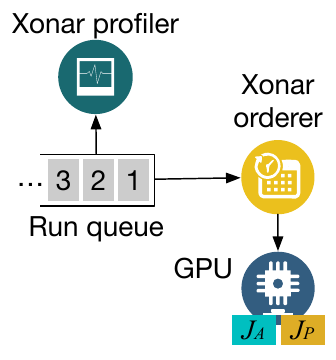
Distributed training alternates GPU computation with idle periods such as communication. Xonar profiles those periods and peak GPU memory, then uses them to choose which queued jobs should run together.
Filter by memory, then match activity
The profiler instruments TensorFlow operations to measure active and idle duration. The orderer first excludes jobs that do not fit the remaining memory, then selects a partner with a complementary active-to-idle ratio.
 View full-size figure
Compare completion time and memory failures
Using offline profiles of 600 configurations, the evaluation samples queues of ten jobs and repeats the experiment 50 times. Xonar reduces average job completion time by up to 43.6% versus serial training and 13.7% versus ordinary parallel training. No out-of-memory failures occur in the evaluated Xonar runs.
| Comparison | Reduction |
|---|---|
| Versus serial training | Up to 43.6% |
| Versus ordinary parallel training | Up to 13.7% |
Key takeaways
- Good job pairs are complementary over time. Profiling exposes opportunities that queue order alone cannot identify.
- Complementarity is useful only within memory capacity. Filtering by peak memory keeps the pairing decision grounded in whether the jobs can coexist.