Paper summary
Translate virtual rules into a white-box pipeline
A tenant’s simple forwarding rule can require several hardware-specific tables underneath.
White-box switches expose restricted forwarding pipelines. WhiteVisor lets a virtual-network controller use its virtual pipeline while translating that pipeline into rules supported by the physical switch.
Convert virtual rules into the supported table sequence
A pipeline handler translates the virtual forwarding request into the physical switch’s required flow and group tables. A per-tenant rule store keeps the relationship between the original and generated rules for later operations. The prototype targets OF-DPA 3.0.5 and supports L3 and VLAN routing from a single-table virtual pipeline. For L3 traffic, header matching, rewriting and output are distributed across the physical tables to match the hardware pipeline.
| Routing | OF-DPA | OVS |
|---|---|---|
| L3 | 4.69 ms | 0.28 ms |
| VLAN | 1.58 ms | 0.25 ms |
Separate pipeline setup cost from packet forwarding
Tests on three white-box switches confirm that the generated L3 and VLAN pipelines deliver traffic between VMs. The measured pipeline-processing delay is 4.69 ms for L3 routing and 1.58 ms for VLAN routing, compared with 0.28 and 0.25 ms for OVS. The delay is incurred when the pipeline is installed. The implementation demonstrates these two OF-DPA schemes; support for other physical pipelines and multi-table virtual switches is left for later work.
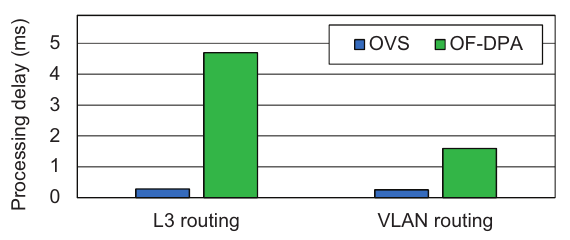 View full-size figure
Key takeaways
- Virtual programmability must fit a concrete hardware pipeline. WhiteVisor bridges the tenant’s rule abstraction and OF-DPA’s required table sequence.
- Translation carries a setup cost. The measured installation delay explains part of that abstraction’s cost without implying an extra delay on every forwarded packet.