Paper summary
Retrieve long-context caches in parallel
Using available memory and storage bandwidth together can shorten the wait before a long-context model begins answering.
Long contexts produce KV caches that extend beyond GPU memory into host memory and SSDs. The paper identifies two delays in retrieving them: traffic concentrated on a small subset of devices, and filesystem processing that dominates SSD access.
Pool the devices and simplify the access path
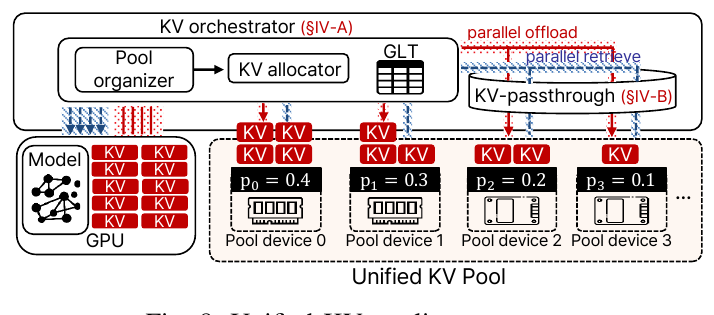
Unified KV pooling treats host-memory modules and SSDs as one logical pool. An orchestrator assigns cache data in proportion to each device’s measured bandwidth and records its location in a global lookup table.
The cache uses multiple devices together to distribute retrieval traffic.
KV-passthrough uses SPDK to access SSD-resident cache data from user space without the kernel filesystem. The design combines device-level parallelism with a shorter software path for those known cache objects.
 View full-size figure
Measure the time to the first token
The evaluation compares LMCache, layerwise pipelining and asynchronous loading variants on LLaMA-3.1-8B, GPT-OSS-20B and Qwen3-30B-A3B. At 128K context, unified KV pooling reports first-token latencies of 5.6, 5.2 and 9.8 seconds respectively.
For GPT-OSS-20B at 128K, this is approximately 4.1× lower latency than LMCache and 3.3× lower than the variant with both pipelining and asynchronous loading. An ablation separately enables pooling and passthrough; the combined design performs better than either component alone.
| Model | Latency |
|---|---|
| LLaMA-3.1-8B | 5.6 s |
| GPT-OSS-20B | 5.2 s |
| Qwen3-30B-A3B | 9.8 s |
Key takeaways
- KV offloading is limited by both device balance and software overhead. Bandwidth-weighted pooling and direct SSD access address different parts of the same data path.
- The mechanisms reinforce each other in the measured system. The ablation attributes lower first-token latency to pooling and passthrough together.