Paper summary
Keep wearable measurements usable and verifiable
Wearable data needs a consistent path from collection to clinical review, with checks on both stored integrity and measurement quality.
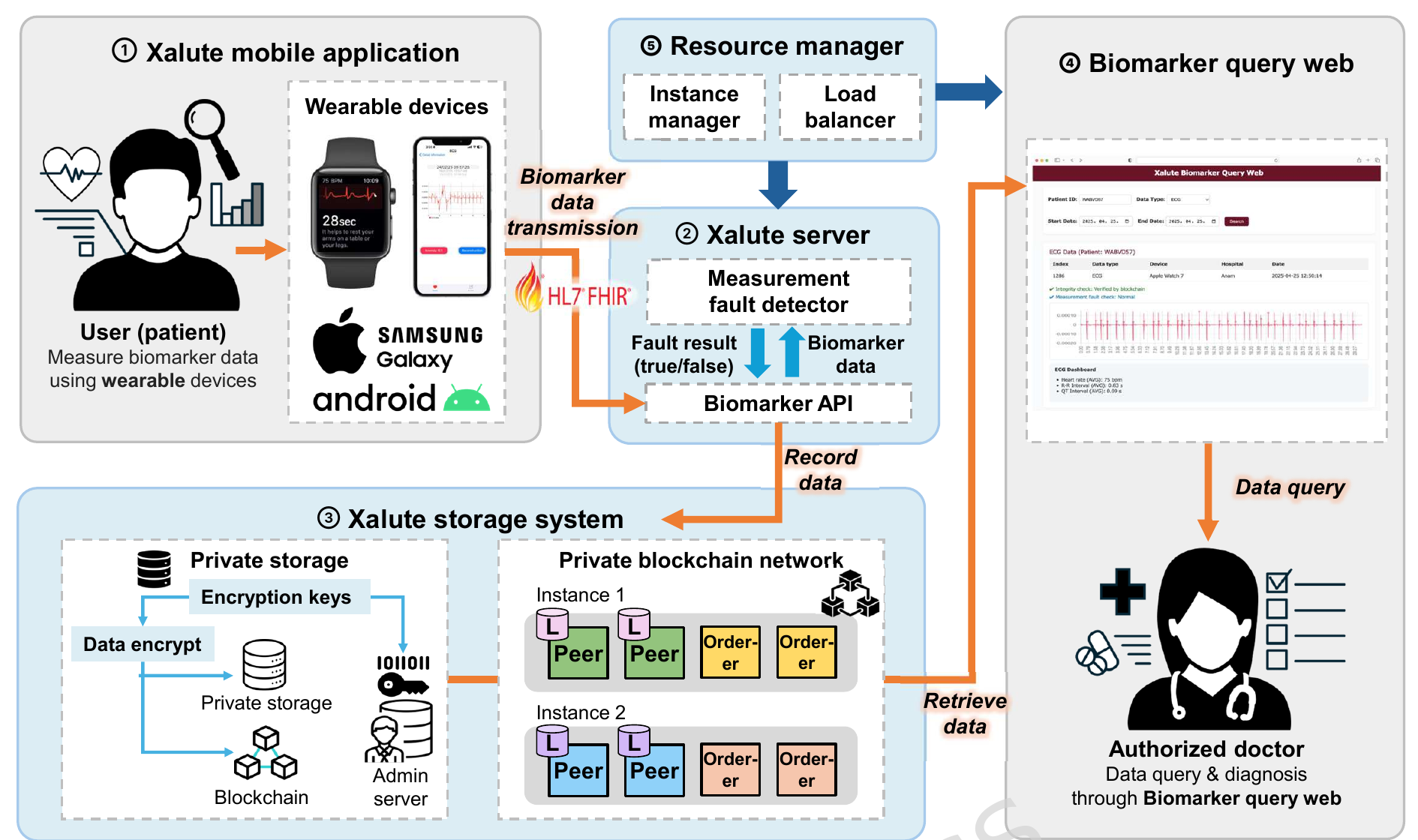
ECG time series and dietary images arrive in different formats, and a correctly stored record may still contain a poor measurement. Xalute separates these concerns in a cloud platform connecting wearable devices, a mobile application and a clinician-facing web service.
Combine a common interface with independent checks
A FHIR-based API accepts the different biomarker formats. The raw data is encrypted in private storage, while a private blockchain records hashes used to detect subsequent changes. A Gaussian-mixture-model component separately screens measurement quality; resource management scales the service as load increases.
Hash verification protects record integrity, while quality screening assesses the measurement.
 View full-size figure
Evaluate the data pipeline in a clinical setting
The study enrolls 100 patients with atrial fibrillation at Korea University Anam Hospital and deploys the backend on Google Cloud. In the integrity experiment, the platform detects all 500 deliberately modified samples by comparing their hashes with the stored records.
A separate transmission experiment uses 500 ECG signals and 500 dietary images. Average end-to-end latency is 1.76 seconds, measured through storage in both the private database and blockchain ledger.
| Metric | Result |
|---|---|
| Deliberately modified records detected | 500 of 500 |
| Average end-to-end storage latency | 1.76 seconds |
Key takeaways
- A common workflow can span unlike biomedical records. Numeric ECG data and dietary images enter the same collection and authorized-review platform.
- Record integrity and measurement quality are separate questions. Hash verification checks stored content, while screening addresses the quality of the original measurement.