Paper summary
Split traffic to meet tenant throughput requests
Multiple physical paths can contribute to a tenant’s requested throughput.
TALON reconstructs the path chosen by a tenant controller, then allocates throughput using available capacity across physical links. It preserves priority for the tenant’s main path while adding subpaths.
Prioritize the main path before adding subpaths
The hypervisor reconstructs an end-to-end path from the tenant’s flow rules and checks its available capacity against the requested throughput. If the main path can carry the request, no extra splitting is needed. Otherwise, TALON can move another tenant’s subpaths to free capacity, while keeping main paths prioritized. It then calculates additional subpaths for any remaining demand and installs OpenFlow group rules to split traffic at ingress and join it at egress.
| Stage | Action |
|---|---|
| Main path | Use available capacity first |
| Existing subpaths | Reassign them when needed to free capacity |
| Remaining demand | Add subpaths and install split/join rules |
Meet two tenants’ requests through traffic splitting
In a Mininet test with two ONOS-controlled tenants requesting 200 Mbps each, TALON brings both throughputs close to their targets; the simultaneous-start experiment reports improvements of 2.08× and 2.29×. A separate staggered-start experiment shows how traffic is redistributed when the second tenant joins, with average throughputs of 209.7 and 196.5 Mbps.
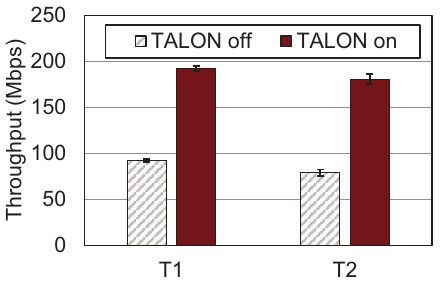 View full-size figure
Key takeaways
- A tenant’s preferred route may not carry its requested rate alone. TALON preserves main-path priority while using additional paths to supply capacity.
- Multipath allocation makes the throughput request actionable. In the simultaneous-tenant test, achieved rates move toward each tenant’s 200-Mbps target.