Paper summary
Make traffic weights match the traffic split
A weighted path selector should send the intended share of connections to each path.
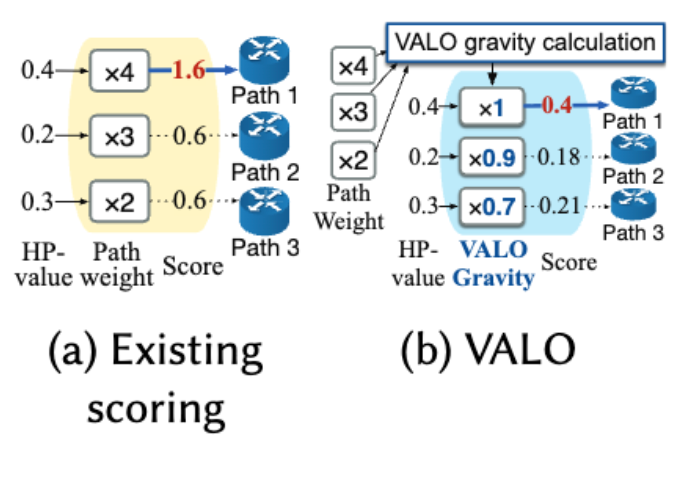
Weighted traffic splitting assigns different shares of traffic to available paths. The paper shows that multiplying a connection’s hash score by a path weight can produce a split that differs from the requested weights. VALO addresses the selection rule behind that mismatch.
Translate weights into selection probabilities
A score graph represents which path wins for each possible combination of hash scores. The volume of a path’s winning region determines its selection probability. VALO computes adjusted weights, called gravity values, so those volumes match the requested traffic proportions.
The adjustment connects the requested proportions to the path-selection probabilities.
Gravity values are recalculated when weights change. Connection selection then multiplies the hash scores by those values and chooses the highest score, retaining a lightweight selection path.
 View full-size figure
Evaluate splitting and application completion time
The implementation uses Open vSwitch. Microbenchmarks measure how accurately connections follow the desired weights; application experiments use web-search, data-mining, deep-learning and Twitter-cache workloads.
The paper compares VALO with random selection, weighted round robin, WCMP and the original scoring approach, reporting improved splitting accuracy and lower mean and tail flow-completion times in its evaluated workloads.
| When | Computation |
|---|---|
| Weights change | Calculate gravity values from winning-region volumes |
| A connection is selected | Multiply hash scores by gravity values and choose the highest score |
Key takeaways
- The score-to-share relationship depends on selection geometry. The geometry of winning regions explains the mismatch between requested and realized allocations.
- Correcting the weights ahead of time keeps the connection decision simple. The evaluation connects the resulting split accuracy to application completion time.