Paper summary
Compare consensus by the resources it consumes
CPU and network measurements reveal the resource cost behind blockchain transaction throughput.
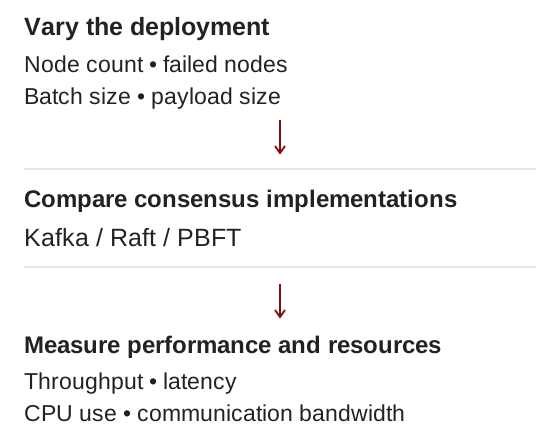
This study compares Kafka, Raft and PBFT in Hyperledger Fabric, measuring resource consumption alongside throughput and latency. It varies ordering-node counts, batch and payload sizes, and failed nodes.
Compare consensus across deployment settings
Containerized nodes run across seven physical servers connected by 10-Gbps Ethernet. The main workload is smallbank, which generates banking transactions. The experiments vary ordering-node count, batch size, payload size and failed nodes, and measure CPU use and network traffic alongside throughput and latency. Profiling also separates nodes that accept or coordinate more work from nodes with lighter roles to expose differences within the ordering service.
 View full-size figure
Distinguish CPU cost, network cost and fault tolerance
The evaluated consensus implementations have different resource profiles. Raft uses less CPU than Kafka and PBFT in the reported comparisons, while Kafka has the lowest network bandwidth in the node-count experiments. Increasing batch size helps throughput only up to a threshold, because transaction arrival and block creation also matter. Node failures change performance and resource use within each algorithm’s fault-tolerable range; exceeding that range causes sharp throughput losses.
| Comparison | Observed pattern |
|---|---|
| CPU consumption | Raft uses less than Kafka and PBFT |
| Network use as node count varies | Kafka uses the least bandwidth |
| Work across ordering nodes | CPU consumption differs by node role |
Key takeaways
- Consensus throughput alone hides resource tradeoffs. CPU and network profiles distinguish implementations that transaction rate cannot fully describe.
- Resource cost depends on deployment choices and node roles. Batch size, node count, failures and unequal ordering work all affect the measured behavior.