Paper summary
Place blockchain peers for a throughput target
Predicting throughput before placement can help choose where to run geographically distributed blockchain peers.
Peer placement changes communication delays and blockchain performance. Cyan predicts the throughput of candidate placements and selects the placement closest to a requested throughput using predicted transactions per second.
Learn placement performance before deployment
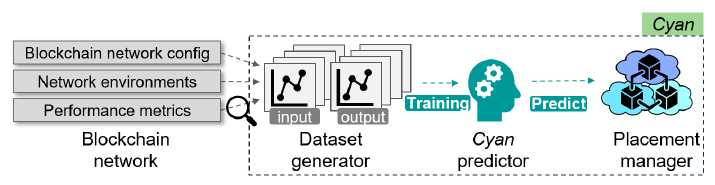
A dataset generator varies peer counts, placement, transaction characteristics and request rates. Cyan trains a performance predictor on 30,000 records, compares candidate placements using predicted transactions per second, and deploys the selected arrangement. Random forest gives the best prediction accuracy among the evaluated models.
 View full-size figure
Check how often placements meet the target
Experiments use Google Cloud in US-east, Europe-west and Asia-northeast regions. Across 1,000 randomized trials, a placement meets the paper’s guarantee criterion when actual throughput falls within 10% of the desired throughput.
Cyan’s guarantee rate is 2.39× that of random placement and 1.52× that of latency-aware placement. The target is actual throughput within 10% of the requested rate.
| Baseline | Cyan guarantee-rate ratio |
|---|---|
| Random placement | 2.39× |
| Latency-aware placement | 1.52× |
Key takeaways
- Blockchain placement must account for the throughput delivered by a network configuration. Predicting the target performance metric gives placement a closer connection to the requested service level.
- A placement prediction is useful when it survives deployment. Target-tolerance measurements connect candidate ranking to the throughput actually obtained.