Paper summary
Predict what resource scaling will deliver
Adding blockchain resources is easier to plan when their effect on successful transactions and throughput can be estimated.
Permissioned blockchain performance depends on how resources are distributed across peers as well as on transaction load. This study builds separate predictors for transaction success rate and throughput to support resource-scaling decisions in Hyperledger Fabric.
Learn from peer counts, CPU quotas and request rates
The authors collect 593 records by varying peer counts, per-peer CPU quotas and transaction request rates. They compare regression algorithms and train two random-forest models, tuning their hyperparameters through grid search.
Separate outputs distinguish how many transactions complete from the rate at which the blockchain commits them.
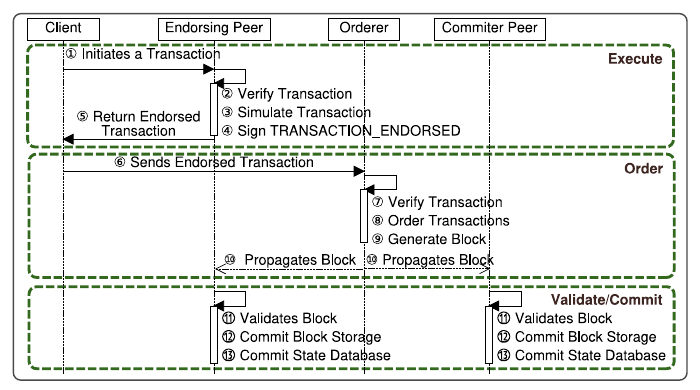 View full-size figure
Evaluate errors and scaling examples
With an 80/20 training and test split, random forest achieves symmetric mean absolute percentage errors of 5.6% for success rate and 1.9% for throughput. It has the lowest errors among the five evaluated regression algorithms.
The paper then uses the models to compare scaling configurations and identify allocations for desired performance. These use cases connect the predictions to concrete CPU and peer-count choices.
| Predicted metric | sMAPE |
|---|---|
| Transaction success rate | 5.6% |
| Transaction throughput | 1.9% |
Key takeaways
- Resource scaling changes more than raw transaction rate. Modeling success rate alongside throughput distinguishes accepted work from merely offered load.
- Configuration-aware prediction makes allocations comparable. CPU quota and peer count let the model estimate the consequences of a proposed resource choice.