Paper summary
Optimize the tools as well as the model
Agent latency depends on local tool execution and remote model response time.
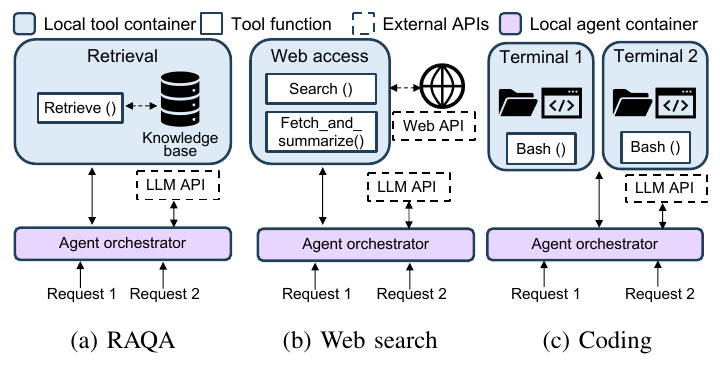
An agent alternates remote model calls with local tool execution. The paper measures how this loop behaves for retrieval-augmented question answering, web search and coding, showing that these tasks place different demands on CPU, memory and disk I/O.
Measure the execution loop before allocating resources
The study covers seven benchmarks on an Azure VM with 24 vCPUs and 216 GB of memory. It records Gemini 3 Flash outputs and per-step latency, then replays those outputs while executing the corresponding tool calls, keeping model-response variability from confounding resource comparisons.
The same agent framework can need different resource policies for different tasks.
Measurements separate model waiting from tool work and vary request concurrency and CPU allocation. Retrieval-heavy tasks show strong CPU sensitivity, web search is dominated by remote-service waiting, and coding combines local commands, I/O and request-specific state.
 View full-size figure
Test two measurement-guided policies
The authors demonstrate CPU-aware tool admission and task-aware CPU allocation. In a mixture of HotpotQA, BFCLv4 and SWE-bench arriving at 0.5 requests per second each, their six-core policy allocates 3, 1 and 2 cores respectively and applies admission control to HotpotQA.
Compared with an equal two-core allocation, average latency falls by 32%. HotpotQA is 5.4× faster, while BFCLv4 latency increases by 28%. A separate admission-only experiment reduces HotpotQA latency by 3.23× on average but increases SWE-bench latency by 2.76×—direct evidence for selecting the policy by task.
| Workload | Equal | Task-aware |
|---|---|---|
| HotpotQA | 2 cores | 3 cores + admission control |
| BFCLv4 | 2 cores | 1 core |
| SWE-bench | 2 cores | 2 cores |
Key takeaways
- An agent’s resource needs depend on its tool loop. Remote reasoning and local execution contribute differently across tasks.
- One resource policy can help one agent and hurt another. Admission control improves the tested retrieval workload but slows coding.
- Task-aware allocation can improve a fixed budget. The mixed-workload result reduces average latency using the same six CPU cores.