Paper summary
Monitor virtual networks without duplicating collection
Virtual-network measurements can share physical collection work while remaining separate for each tenant.
V-Sight addresses three monitoring problems in SDN virtual networks: counters that mix tenants, delays while gathering statistics, and repeated control-channel traffic.
Translate counters and share collection work
Statistics virtualization derives tenant-specific counters from physical measurements and the virtual-to-physical resource map. Transmission disaggregation collects physical statistics ahead of tenant requests, so a controller does not have to wait for every physical switch when it asks for a counter. Compatible collectors are then merged to reduce repeated control messages. Their timing is adjusted to keep the cached values useful for the different request intervals.
| Mechanism | Role |
|---|---|
| Statistics virtualization | Derive tenant counters from physical measurements |
| Transmission disaggregation | Collect before tenant requests arrive |
| Collector aggregation | Merge compatible collection requests |
Balance faster replies against data freshness
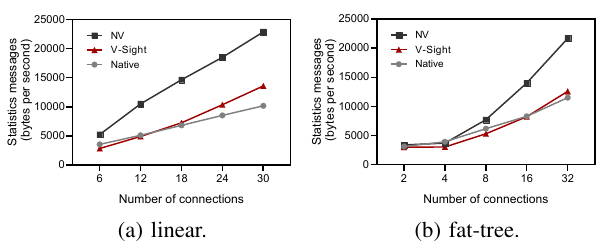
In linear and fat-tree test networks, V-Sight reduces statistics transmission delay and control-channel traffic relative to the OpenVirteX-based virtualized baseline. The largest measured reply delay with V-Sight is below 20 ms, although it remains higher than native SDN in the comparisons. Cached measurements have a time difference between collection and the tenant’s request. The reported average differences stay within 2.5 seconds for the tested five-second request interval.
 View full-size figure
Key takeaways
- Tenant isolation can coexist with shared measurement collection. V-Sight shares physical collection while translating its results into separate tenant statistics.
- Faster replies and fresher measurements are different goals. Cached counters reduce repeated requests, with freshness determined by when those counters were collected.