Publications

Machine Learning-based Prediction Models for Control Traffic in SDN Systems

IEEE Transactions on Services Computing, JCR 2021 IF 11.019 Top 1.4% Volume: 16, Issue: 6, Nov.-Dec. 2023, doi: 10.1109/TSC.2023.3324007.

Yeonho Yoo, Gyeongsik Yang, Changyong Shin, Junseok Lee, Chuck Yoo

Download PDF

Abstract

This article presents Elixir, an automated prediction model formulation framework for control traffic using machine learning. Control traffic is vital in software-defined networking (SDN) systems because it determines the reliability and scalability of the entire system. Various studies have sought to design control traffic prediction models for the proper provisioning and planning of SDN systems. However, previously proposed models are based on descriptive modeling, well-suited for only specific SDN system instances. Furthermore, these models exhibit poor accuracy (errors of up to 85%) because of the heterogeneity of SDN systems. Because descriptive modeling requires a significant amount of human contemplation, it is impossible to formulate adequate prediction models for countless SDN system instances. Elixir addresses this problem by applying machine learning. Elixir starts the model formulation through self-generated datasets. Then, Elixir searches prediction models to fit the accuracy for respective SDN systems. Also, Elixir picks robust models that exhibit reasonable accuracy even in a network topology that differs from the topology used for model training. We evaluate the Elixir framework on nine heterogeneous SDN systems. As a key outcome, Elixir significantly reduces prediction errors, achieving up to 10.6× improvement compared to the previous model for control traffic throughput of OpenDayLight controller.

Paper summary

Choose a control-traffic predictor for the SDN system

Predicting SDN control traffic requires a model suited to the controller and applications that generate it.

SDN control traffic changes with the controller, applications and switch interface. Elixir automates dataset generation and selects predictors for the target SDN system.

Generate measurements and select a robust model

SDN-DAG creates training data for the specified controller, applications and southbound interface. Elixir trains candidate shallow and deep learning models, then selects models using both prediction accuracy and robustness across network topologies.

Selection accounts for prediction accuracy as the network topology changes.
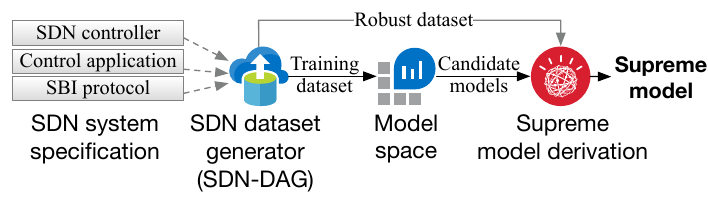
SDN-specific training data feeds candidate predictors, followed by model selection for accuracy and robustness.View full-size figure
SDN-specific training data feeds candidate predictors, followed by model selection for accuracy and robustness.

Test different controller and interface combinations

The implementation evaluates nine SDN instances built from ONOS, OpenDaylight and Floodlight, with OpenFlow versions and applications varied across instances. The robustness evaluation covers eight output features per instance, producing 72 selected models.

Compared with the paper’s naive selection method, Elixir reduces robustness error by 38.1% on average. The result measures prediction error under the evaluated topology changes.

Scope and outcome of Elixir’s topology-robustness evaluation.
QuantityReported value
SDN instances9
Output features per instance8
Selected models72
Average robustness-error reduction versus naive selection38.1%

Key takeaways

  1. Control-traffic prediction is specific to the SDN stack. Controller, application and interface choices determine the behavior a model must learn.
  2. Model selection must account for topology changes. Elixir compares candidate predictors across network structures.