Paper summary
Separate location from identity when forwarding
A VM can move without requiring every forwarding decision to treat it as a new endpoint.
LiteVisor addresses switch-table growth and network reconfiguration after VM migration. Its LITE forwarding scheme separates locator, endpoint identifier and tenant information.
Keep endpoint identity stable when location changes
LITE forwarding separates the location used to route traffic from the endpoint identity and tenant information used to deliver it. The hypervisor translates virtual flows into this physical representation, allowing intermediate switches to aggregate traffic following the same route. Edge switches still perform encapsulation and decapsulation. When notified of a VM move, LiteVisor recalculates the forwarding path for the new location while hiding that physical change from the tenant controller.
| Role | Purpose |
|---|---|
| Location | Route through the physical network |
| Endpoint identity | Identify the destination |
| Tenant information | Maintain the virtual-network context |
Check aggregation and migration as separate outcomes
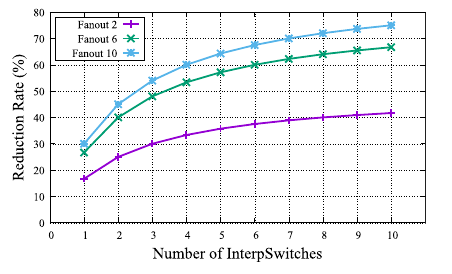
The OpenVirteX-based prototype uses OpenFlow 1.3 and MPLS. Mininet tests cover a linear topology and three fat-tree sizes. In the linear tests, flow-entry reductions range from about 17% to 75%, depending on host fan-out and intermediate-switch count. Edge rules remain necessary for encapsulation, so aggregation benefits differ by switch layer. Migration tests separately measure network reconfiguration time: it grows with the number of intermediate switches, while the tested packet-sending intervals have relatively little effect.
 View full-size figure
Key takeaways
- Separating identity from location benefits both scale and mobility. LITE forwarding supports shared intermediate rules while allowing a moved endpoint’s path to change.
- The scope of the benefit is the forwarding network. Entry reductions and migration-path reconfiguration measure two consequences of that separation.