Paper summary
Make a tenant’s network programmable
Cloud tenants can program virtual network structure and forwarding policy.
Libera implements programmable network infrastructure as a service. The design allows tenants to choose virtual topology and install network policies while the hypervisor translates their requests to the physical network.
Coordinate topology, rule reduction and migration
The hypervisor translates a tenant’s virtual infrastructure and forwarding rules into the physical network. Its scalability component can reduce rules using different matching semantics, while LITE forwarding separates location, endpoint identity and tenant information. Migration handling updates the physical forwarding path when a VM moves, without requiring the tenant controller to participate. These functions work together so that an unmodified SDN controller can manage the tenant’s programmable network.
| Function | Physical-network action |
|---|---|
| Topology translation | Map tenant infrastructure and policies |
| Rule scalability | Merge forwarding under selected matching semantics |
| Migration handling | Update paths when a host moves |
Measure rule savings and network reconfiguration
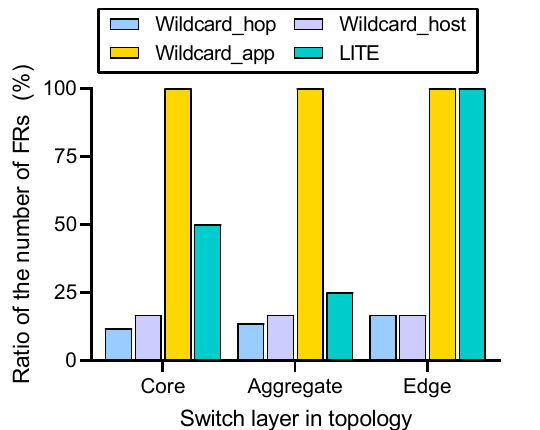
The scalability test compares several forwarding semantics with OpenVirteX in a four-ary fat-tree. The largest core-switch rule reduction is eightfold with hop-based wildcarding; savings depend on the selected semantics and switch layer. A separate hardware-switch migration experiment measures an average of 10.5 ms to reconfigure the network path after a host moves. The paper also measures rule-processing time, memory and control messages as connection count grows.
 View full-size figure
Key takeaways
- Programmable virtualization gives tenants control over network structure as well as connectivity. Libera translates that control into physical topology and forwarding policies.
- Rule scalability and mobility share the same translation layer. Their coordination lets physical forwarding change without requiring the tenant controller to manage the underlying infrastructure.