Paper summary
Keep a participant’s data in federated training
Coordinating devices owned by the same participant can include more of that participant’s data in training.
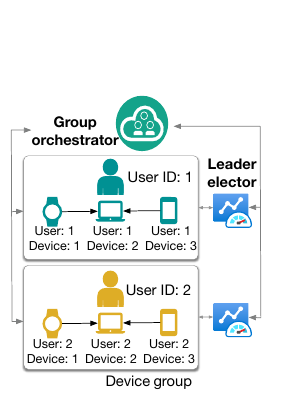
Federated learning can leave slow devices behind, excluding the data they hold. Harmonia groups devices belonging to the same owner and uses a faster device within each group to train on the group’s combined dataset.
Select a training leader within each owner’s group
Devices profile a training iteration, and the fastest eligible device becomes the group leader. Data moves to that leader within the owner’s group; unchanged data does not need to be transferred again. Leader selection is refreshed periodically, and the server combines group updates using FedAvg.
The grouping changes where a participant’s data is processed without pooling data across different owners.
 View full-size figure
Test heterogeneous devices and data
The prototype uses three Raspberry Pis and two Jetson devices divided between two owners. Experiments vary the distribution and quantity of data across devices and compare Harmonia with TiFL and FedAvg.
In the quantity-heterogeneity experiment, converged accuracy is 1.71× TiFL’s and 1.61× FedAvg’s. The experiment evaluates the benefit of including group datasets through leader-based training.
| Baseline | Harmonia / baseline accuracy |
|---|---|
| TiFL | 1.71× |
| FedAvg | 1.61× |
Key takeaways
- Slow devices can contribute data without doing all the training. Harmonia shifts computation to a faster device within the same owner’s group.
- Device heterogeneity becomes a leadership decision. Periodic profiling adapts which device trains while preserving the boundary between participant groups.