Paper summary
Virtualize forwarding rules as well as addresses
Several compatible virtual rules can share a physical rule without giving up tenant control.
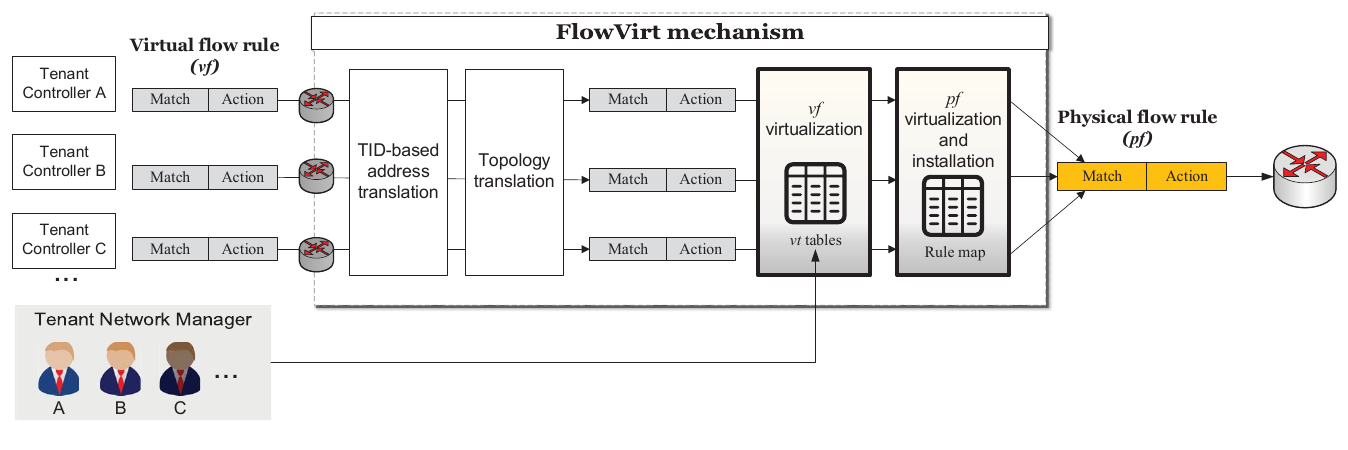
Programmable network virtualization can fill switch tables with separate rules for similar traffic. FlowVirt separates virtual flow rules from physical flow rules and controls how they are merged.
Merge compatible rules under tenant policy
FlowVirt keeps virtual rules distinct from the physical rules installed on switches. It selects a virtualization type, changes the physical match fields accordingly and records the mapping. Before merging rules, it checks action conflicts and the tenant’s isolation requirements. The permitted granularity matters: traffic that can share a next hop need not always remain separate by endpoint or application, but a tenant policy can require those distinctions.
 View full-size figure
Reduce switch state and control traffic together
The OpenVirteX-based prototype is tested with Mininet in linear, Internet2 and fat-tree topologies. The paper reports reductions of up to tenfold in flow-rule count and control-channel bandwidth relative to OpenVirteX. Although virtualization adds computation, fewer rules and messages reduce overall CPU use by up to 32% in the reported tests. The amount of merging depends on traffic paths and tenant policy.
| Metric | Reduction |
|---|---|
| Flow-rule count | Up to 10× |
| Control-channel bandwidth | Up to 10× |
| CPU use | Up to 32% |
Key takeaways
- Multiple virtual rules can share a physical forwarding entry. FlowVirt treats that mapping as a scalability mechanism.
- Aggregation must preserve policy meaning. Compatibility and action-conflict checks determine which tenant rules can safely share an installed entry.