Paper summary
Reserve a backup route that can carry the traffic
A failover route must preserve bandwidth as well as connectivity.
FAVE addresses failures in shared SDN virtual networks. Moving traffic to a backup path can interfere with another tenant, so the backup calculation considers both tenant bandwidth requirements and existing reservations.
Reserve capacity for both primary and backup routes
The route calculator excludes links on the tenant’s primary route and links without sufficient available capacity. It also checks whether existing backup routes would interfere with a newly requested primary route and recalculates them when necessary.
| Check | Action |
|---|---|
| Primary-route overlap | Exclude primary links |
| Available capacity | Exclude links with insufficient bandwidth |
| Conflict with another primary route | Recalculate the affected backup |
Keep both tenants forwarding after a link failure
The OpenVirteX implementation uses ONOS tenant controllers in a fat-tree test network. A link serving tenant 1 is broken during the experiment. Its reserved backup route takes over, and both tenants retain nearly the same throughput in the reported test. FAVE also moves a backup reservation when it would interfere with another tenant’s primary route.
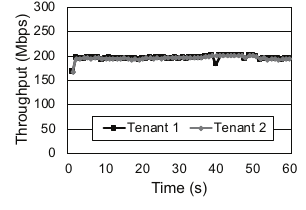 View full-size figure
Key takeaways
- A backup route needs capacity as well as connectivity. FAVE includes reserved bandwidth in failover planning.
- Recovery for one tenant must account for other tenants’ routes. Coordinating primary and backup reservations supports the nearly unchanged throughput observed during the tested link failure.