Paper summary
Allocate virtual links against current physical traffic
A virtual link’s physical route should account for topology and available capacity.
A big link abstracts several physical links into one virtual connection. BAS postpones physical allocation until traffic arrives and revisits the allocation when other tenants change the load.
Delay allocation until traffic arrives, then revise it
Initialization creates the virtual link endpoints without fixing a physical route. When traffic arrives, BAS selects resources using monitored physical-link load. Soft reallocation handles opportunities between flows, while hard reallocation revisits active assignments. The implementation installs a new forwarding policy before removing the old one and orders rule changes to limit packet loss. It also evaluates an asynchronous alternative that handles packets arriving during rule replacement.
| Operation | Timing |
|---|---|
| Initial allocation | When traffic arrives |
| Soft reallocation | Between flows |
| Hard reallocation | While assignments are active |
Adapt the big link when another tenant adds traffic
The OpenVirteX prototype is evaluated with two virtual networks in Mininet: one adds competing load and the other uses the big link. Under the heavier initial bottleneck loads, BAS achieves 2.7–3.8 times the throughput of OpenVirteX in the reported test; at lighter loads, the results are similar. When competing traffic starts later, reallocation restores much of the big link’s throughput. The experiments also assess packet loss and throughput fluctuation during route changes. A guaranteed bandwidth or latency service is left for future work.
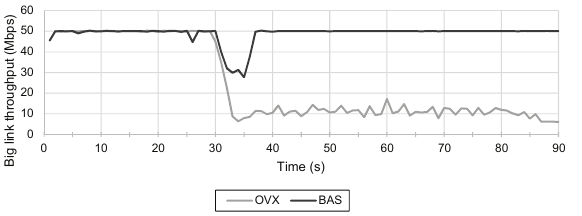 View full-size figure
Key takeaways
- A virtual link’s best physical allocation depends on current contention. BAS delays allocation until traffic arrives and revisits it as other tenants change the load.
- Reallocation is part of maintaining the abstraction. Coordinated rule replacement lets the big link recover throughput when the original route becomes constrained.