Paper summary
Measure the link without timing the controller path
Switch-to-switch echo timing can keep controller processing out of a link-latency measurement.
Controller-mediated latency probes can include delays from control traffic and controller work. This paper implements BFD Echo mode in Open vSwitch so that link measurements are taken between neighboring switches.
Time an echo at the switch and report it separately
BFD Echo mode is implemented in Open vSwitch. A neighboring switch returns the echo and the originating switch measures the exchange, separately from the normal forwarding-table pipeline. LLDP then carries the measured value to the controller. Local timing keeps control-plane reporting delay outside the link-latency measurement.
| Operation | Where it happens |
|---|---|
| Echo timing | At the originating switch |
| Echo return | At the neighboring switch |
| Result reporting | LLDP carries the measured value to the controller |
Compare latency estimates as the network grows
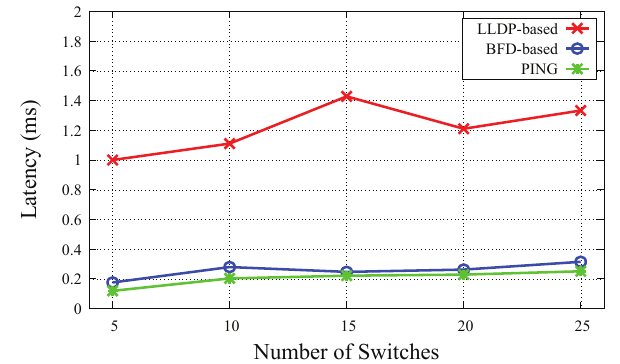
The Mininet evaluation uses Open vSwitch and Floodlight on separate servers and grows a linear topology from five to 25 switches. BFD-based estimates remain much closer to the ping-derived half-round-trip reference than the LLDP-based estimates, without the calibration used by some controller-mediated approaches. The tests also examine the effect of rising control-plane traffic. The emulated-network tests use ping-derived latency as their comparison reference.
 View full-size figure
Key takeaways
- Controller-mediated timing can include delay beyond the link itself. Measuring the echo at the switch separates local timing from the reporting path.
- That separation improves agreement with the comparison reference. BFD-based estimates remain closer to ping-derived latency across the tested network sizes.