Publications

Bandwidth Isolation Guarantee for SDN Virtual Networks

IEEE INFOCOM 2021 - IEEE Conference on Computer Communications, Acceptance rate 19.9%, Virtual (originally in, Vancouver, BC, Canada), 2021, pp. 1-10, doi: 10.1109/INFOCOM42981.2021.9488797.

Gyeongsik Yang, Yeonho Yoo, Minkoo Kang, Heesang Jin, Chuck Yoo

Download PDF

Abstract

We introduce TeaVisor, which provides bandwidth isolation guarantee for software-defined networking (SDN)-based network virtualization (NV). SDN-NV provides topology and address virtualization while allowing flexible resource provisioning, control, and monitoring of virtual networks. However, to the best of our knowledge, the bandwidth isolation guarantee, which is essential for providing stable and reliable throughput on network services, is missing in SDN-NV. Without bandwidth isolation guarantee, tenants suffer degraded service quality and significant revenue loss. In fact, we find that the existing studies on bandwidth isolation guarantees are insufficient for SDN-NV. With SDN-NV, routing is performed by tenants, and existing studies have not addressed the overloaded link problem. To solve this problem, TeaVisor designs three components: path virtualization, bandwidth reservation, and path establishment, which utilize multipath routing. With these, TeaVisor achieves the bandwidth isolation guarantee while preserving the routing of the tenants. In addition, TeaVisor guarantees the minimum and maximum amounts of bandwidth simultaneously. We fully implement TeaVisor, and the comprehensive evaluation results show that near-zero error rates on achieving the bandwidth isolation guarantee. We also present an overhead analysis of control traffic and memory consumption.

Paper summary

Reserve bandwidth along a tenant’s virtual path

Bandwidth requirements apply across the complete forwarding path.

TeaVisor accepts minimum and maximum bandwidth requirements between tenant endpoints. It reconstructs the virtual forwarding path from tenant rules and uses physical capacity information to provide bandwidth isolation.

Connect virtual paths to bandwidth reservations

Path virtualization identifies the end-to-end virtual path. Bandwidth reservation assigns physical capacity, and path establishment installs the corresponding forwarding rules. The components coordinate the tenant’s logical path with the physical resources that carry its traffic.
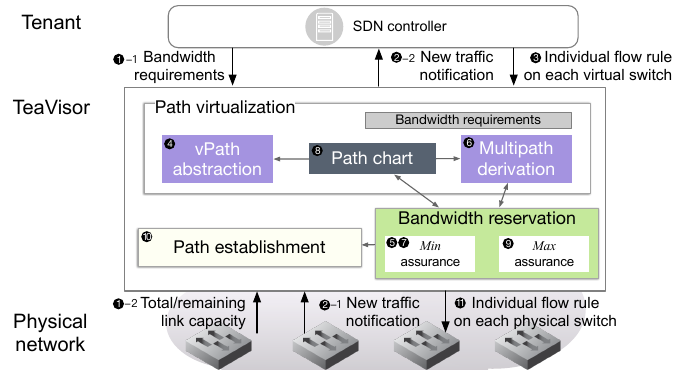
Tenant bandwidth requirements pass through path virtualization, reservation and physical rule installation.View full-size figure
Tenant bandwidth requirements pass through path virtualization, reservation and physical rule installation.

Check minimum and maximum bandwidth isolation

The conference paper evaluates minimum and maximum bandwidth requirements and implementation overhead. It reports near-zero bandwidth-isolation error in the tested cases and no additional memory consumption relative to its existing-hypervisor comparison after optimization.

How an end-to-end bandwidth requirement reaches the physical network.
StageRole
Path virtualizationIdentify the tenant’s end-to-end path
Bandwidth reservationAssign physical capacity
Path establishmentInstall the corresponding forwarding rules

Key takeaways

  1. Bandwidth isolation is an end-to-end property. A tenant’s minimum and maximum rates must be reflected in both path selection and capacity reservations.
  2. A virtual route carries resource commitments. Reconstructing its physical path connects the tenant’s requirement to the rules that enforce it.