Paper summary
Adapt the bandwidth of SDN control channels
A shared control path can be fairer when channel limits follow measured use.
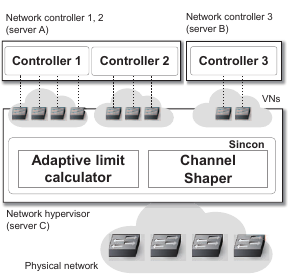
Control channels from different tenants compete at the network hypervisor. Sincon measures their throughput and adapts per-channel limits to control interference.
Adjust limits and shape each channel
An adaptive limit calculator divides initial capacity among channels and adjusts limits according to observed usage and available capacity. A channel shaper enforces those limits on control traffic.
 View full-size figure
Measure fairness and forwarding setup time
Compared with OpenVirteX, the evaluation reports a reduction of up to 3.8× in the standard deviation of channel throughput. With four tenants, forwarding setup time improves by up to 2.9×. The experiments connect more balanced control-channel use to lower setup delay.
| Metric | Improvement |
|---|---|
| Channel-throughput standard deviation | Up to 3.8× lower |
| Forwarding setup time, four tenants | Up to 2.9× faster |
Key takeaways
- Shared control channels need isolation that follows demand. Updating shaping limits from observed throughput addresses interference without treating every channel’s workload as constant.