Paper summary
Let placement change the simulated network cost
A training simulator becomes more faithful when it accounts for which running jobs actually share network capacity.
Distributed training repeatedly synchronizes gradients. A scheduler decides which jobs overlap and whether their workers share server network interfaces or inter-server links. Simulating every job at its isolated speed—or adding the same fixed slowdown—misses how these decisions change completion times.
Update contention as the cluster changes
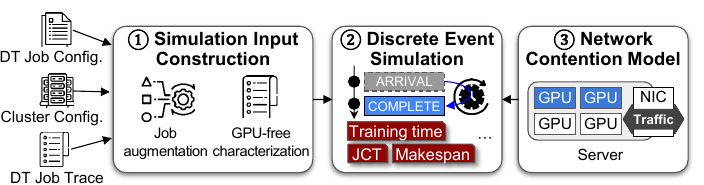
MOSIM augments public job traces with workload descriptions and uses GPU-free characterization to obtain compute time, networking time and communication volume. A discrete-event simulator then applies scheduling decisions and tracks arrivals, completions and progress.
Network cost changes with the current placement and overlap of jobs.
The contention model derives demand on shared network interfaces from worker assignments and communication volume, then updates affected jobs’ iteration times. The paper’s bandwidth-demand formulation assumes synchronous data-parallel training with ring all-reduce.
 View full-size figure
Compare simulated times with a physical cluster
The main validation replays a 13-hour, 60-job workload derived from the Philly trace on four eight-V100 servers. Physical measurements provide ground truth under both bin-packing and load-balancing placement.
Under bin packing, MOSIM’s mean absolute percentage error for average job completion time is 11.10%, versus 36.38% for Tiresias and 33.00% for Pollux. Under load balancing, its P99 completion-time error is 8.38%, versus 65.28% and 63.89%. The errors compare simulated completion times with physical-cluster measurements.
| Metric / placement | MOSIM | Tiresias | Pollux |
|---|---|---|---|
| Average JCT / bin packing | 11.10% | 36.38% | 33.00% |
| P99 JCT / load balancing | 8.38% | 65.28% | 63.89% |
Key takeaways
- Network contention changes with scheduling decisions. A simulator must update shared capacity as jobs overlap.
- GPU-free characterization can support cluster-level prediction. Separating compute and network behavior supplies the inputs used to reproduce completion-time behavior under different placements.