Paper summary
Give each virtual network its own timely statistics
A tenant needs measurements of its own network, even when physical resources are shared.
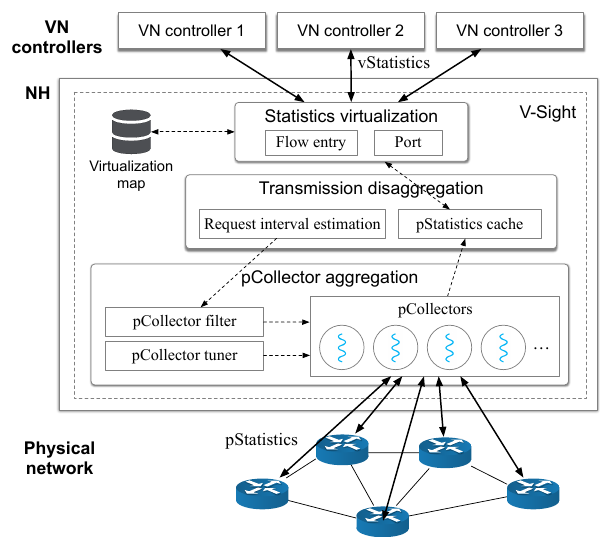
Physical switch counters can mix traffic from several virtual networks. V-Sight translates those counters into tenant-specific statistics while addressing the delay and control traffic caused by collecting them.
Translate statistics and coordinate collection
Statistics virtualization uses the virtual-to-physical resource map to calculate the requested counters. Transmission disaggregation prepares physical statistics in a cache before requests arrive. Collector aggregation combines overlapping collection work and adjusts its timing.
 View full-size figure
Check accuracy, delay and collection cost
The journal study evaluates statistics accuracy, collection delay and control-channel consumption, as well as cache time skew and CPU and memory use. It also examines effects on tenant traffic, reporting monitoring behavior and data-plane throughput close to the non-virtualized SDN comparison.
| Mechanism | What it changes |
|---|---|
| Statistics virtualization | Translate physical counters into tenant statistics |
| Transmission disaggregation | Prepare counters in a cache before requests arrive |
| Collector aggregation | Combine overlapping collection and adjust its timing |
Key takeaways
- Tenant isolation extends to observability. The virtualization mapping translates physical counters into meaningful tenant statistics.
- Independent monitoring requests can share physical work. Reusing collection reduces redundant traffic while keeping the returned statistics tenant-specific.