Paper summary
Measure the cost of programmable virtual networks
Network virtualization can be assessed separately for packet forwarding and for the hypervisor that manages it.
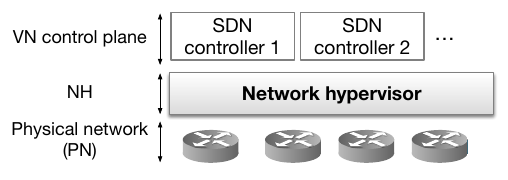
This benchmarking study investigates whether the overhead of SDN-based network virtualization prevents practical use. It separates data-plane behavior from network-hypervisor overhead so that the two costs can be examined directly.
Benchmark forwarding and hypervisors separately
The data-plane tests compare overlay networking, NAT, address mapping, tenant-ID embedding and locator embedding. Separate hypervisor tests vary switches, flows and virtual networks, using linear and fat-tree topologies.
 View full-size figure
Compare performance as networks grow
The tested SDN-based techniques are competitive with overlay networking in data-plane performance and exceed it in some experiments. The study also reports that hypervisor overhead mostly remains constant as its tested network dimensions increase.
| Evaluation | Compared or varied |
|---|---|
| Data plane | Overlay, NAT, address mapping, tenant-ID and locator embedding |
| Hypervisor | Switch, flow and virtual-network counts |
| Topology | Linear and fat-tree networks |
Key takeaways
- The cost of programmability has more than one source. Separating forwarding and hypervisor-processing costs makes the implementation tradeoff visible.