Paper summary
Connect the O-RAN architecture to its interfaces
Understanding an open radio network requires knowing both what its interfaces specify and what software implements.
This 2024 review examines the interfaces connecting O-RAN components and compares their roles with the O-RAN Software Community implementation. It links the architecture’s intended control and management functions to the available software.
Follow control and management across components
A1 carries policy between the non-real-time and near-real-time controllers, while E2 connects near-real-time control to network nodes. O1 supports management of network elements; O2 connects service management to cloud infrastructure and deployment services. Open Fronthaul connects distributed and radio units.
These interfaces divide responsibility across policy, radio control, management and cloud resources.
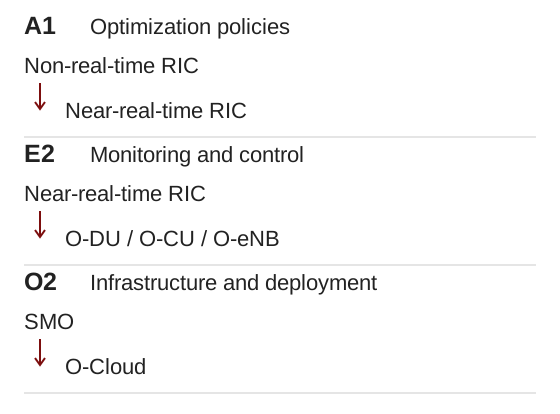 View full-size figure
Review implementation coverage
The paper’s implementation snapshot identifies A1, E2 and O2 support, with partial coverage for O1 and Open Fronthaul. It discusses missing management-plane functionality in that snapshot.
The authors also discuss resource provisioning through O2 and the need to consider its timing requirements. The review documents the implementation state and research directions in 2024.
| Interface | Responsibility |
|---|---|
| A1 | Policy between non-real-time and near-real-time controllers |
| E2 | Near-real-time control of network nodes |
| O1 | Network-element management |
| O2 | Cloud infrastructure and deployment services |
| Open Fronthaul | Connection between distributed and radio units |
Key takeaways
- O-RAN’s interfaces divide distinct responsibilities. Radio control, service management and cloud provisioning use distinct interfaces and responsibilities.
- Implementation coverage remains uneven across architectural roles. Comparing specifications with code exposes the gaps that motivate further work, including O2 resource-management timing.